A few years back I gave a talk at an AO conference about the riches. I told a story about my grand-daughter Lizzie and a trip her family took to their local art museum. Lizzie was only five at the time and so most of the advanced preparations her mother made were focused on her older brother, who was school aged. But Lizzie met a painting called The Grief of the Pasha, and Lizzie fell in love. Those were her mother's words in an email she sent about the visit, and they are quite apt. (for the full story, you'd need to listen to the recording of the talk, information below)
Falling in love is an important key to learning. Picture study takes perhaps five or ten minutes every other week, but it can be the beginning of a life long love affair, and the door to learning other things as well. Picture study also will help your students improve their moods and sharpen their thinking for other studies during the day as well.
Subjects undergoing an MRI while looking at artworks they considered most beautiful showed increased blood flow in a certain part of the brain by as much as 10 per cent – the same brain area and same increase in blood flow as when gazing at a loved one.The Power of Art
Viewing art triggers higher-order mental processing The human brain is designed to enjoy art
A study from the University of Westminster found that participants' stress levels decreased after a lunchtime visit to an art gallery. Participants who came in w/ high levels, had lower concentrations of cortisol, commonly known as the stress hormone, 30 min. later. And the effect was most marked for those who were most stressed. Think about what this means for improving the atmosphere while doing lessons! Spend a few minutes looking at your art for the week right after a stressful lesson- art isn’t an extra, it’s a basic necessity for school.
Normalisation of salivary cortisol levels and self-report stress by a brief lunchtime visit to an art gallery by London City workers, Clow & Fredhoi
After analyzing 15 studies that had people looking at art for different reasons, neuroscientist Oshin Vartanian explained in a Q&A that "areas of the brain involved in processing emotion and those that activate our pleasure and reward systems are also being engaged." Essentially, parts of the brain that are associated with contemplation are automatically sparked when viewing art, even if they aren't thinking about it critically
The fantastic effect of art on mind and body
Drawing is another part of the curriculum often skipped, but drawing helps with learning and memory as well. I would suggest you try this at home with reluctant artists/narratorsm but don't tell them ahead of time what you are doing. Just during the day tell them two different stories, similar in length and interest. Have them sketch what they recall of one, just move on through your day without drawing the other. Later in the day, ask for a short narration of each and see what happens. Drawing helps you remember, how well you drew is irrelevant, Science Daily: If you need to remember something, draw it., even if you only have 4 seconds; Drawing helps memory, even if you only draw for four seconds. TechTimes
Nature Journals (and nature studies) are, regrettably, frequently skipped until people can get their schedules under control, but this is a beautiful thing in its own right, and it also, happily, well help your other subjects go more smoothly:
Karen Matsumoto wrote a beautiful article on nature journaling, published on John Hopkins’ School of Education website. She says: “In my experience working with children, I have found that the act of drawing and writing helps students to see and know nature through attention to and expression of their feelings. Feelings are a part of learning; it is now known that feelings are essential to deep understanding and sound decision making. Because attitudinal, emotional, and aesthetic considerations are important for growth and development, journals can be a good vehicle for "starting where children are." Rachel Carson, naturalist and writer, suggested that feelings help start the process of children wanting to know (1956). "Once the emotions have been aroused - a sense of the beautiful, the excitement of the new and unknown, a feeling of sympathy, pity, admiration, or love - then we wish for knowledge about the object of our emotional response. Once found it has lasting meaning."." Nature Journaling by Matsumoto
And the same day I found that article, I read this comment in one of our groups, by Rusty Parker, enthusiastic over all the new thing she was seeing in her own backyard- “It's amazing what I'm seeing now that I care!” This gives new depth and meaning to Mason's comments on what matters most at the end of our school days is not what we know, but how much do we care, and about how many things do we care, doesn't it?
Go outside and look at the natural world. Find things that make you all share a collective sense of amazement, of awe, things that make you go, "Ahhh!"
"...awe helps bind us to others, motivating us to act in collaborative ways that enable strong groups and cohesive communities." The importance of shared awe
"we tested the hypothesis that awe can result in a diminishment of the individual self and its concerns, and increase prosocial behavior. In a representative national sample (Study 1), dispositional tendencies to experience awe predicted greater generosity in an economic game above and beyond other prosocial emotions (e.g., compassion). In follow-up experiments, inductions of awe (relative to various control states) increased ethical decision-making (Study 2), generosity (Study 3), and prosocial values (Study 4). Finally, a naturalistic induction of awe in which participants stood in a grove of towering trees enhanced prosocial helping behavior and decreased entitlement compared to participants in a control condition (Study 5)." (Shared experiences of awe increase social cooperation and decrease self-centeredness)
Narration and discussion, saying things out loud, also helps with memory: John Muir Laws on saying aloud: Prompts for deeper nature observation: Saying aloud helps you remember later
Many will find the materials here to be helpful: http://beetlesproject.org/
A few days after their visit to the art museum, a friend shared a poem about the Pasha's grief w/ Lizzie's mama. It is a long poem, written by Victor Hugo in 1827, and I would not think most 5 year olds would have cared for it or understood it. Lizzie's mama read her the poem anyway (linked here: https://www.joslyn.org/Post/sections/375...lation.pdf) and reports that in conclusion, Lizzie was running around the house hollering "I was right! I was right! He was sad because his tiger died!"
The riches are not extra. They will nourish your souls and bind your hearts together, give your studies energy, life, and vitality. Do not skip them.
You can buy the recording of this talk here. The recording has a lot of additional material. It is not a duplicate of this post.

Who am I? Christian, Mom of 7, grandma to 14, 'retired' homeschool mom after 29 years, AmblesideOnline Advisory member. I've camped on the Al-Can highway, snorkeled in the China Sea. I blog about Charlotte Mason, books, travel, and more. Posts often include affiliate links. I promise not to waste your time.
Showing posts with label picture study. Show all posts
Showing posts with label picture study. Show all posts
Thursday, May 23, 2019

Wednesday, May 22, 2019
Seven kids, their friends, my friends, and a field trip
Several years ago there was a Leonardo Da Vinci exhibit in a museum in Canada. It was the last time these works would be seen anywhere on the North American Continent for many years, perhaps ever. We planned a field trip with two other homeschooling mothers and some of their kids. I took all seven of mine, which included a nursing baby, a potty training toddler, and a potty training 11 year old with multiple severe disabilities. Yes, I am insane. But my husband was active duty military, we never lived near any family and if I didn't do stuff like this on my own, we just wouldn't have gone anywhere. Which, in retrospect, might have been the saner choice, but we have established that sanity is not in my skillset.
We planned it and looked forward to it for months. I gloated to all my friends, both real and virtual, about the cultural treat in store of us. About a week after the event, I wrote my friends about our experiences. Here it is:
I would love to regale you all with a fine narration of the deeply meaningful experience I had visiting the Leonardo Da Vinci exhibit in Victoria, B.C. last Monday. My seven children and I rode in a borrowed 15 passenger van with Tootles and her 13 y.o. daughter, and another friend and her five children. We had, you know, been planning this dream field trip for a few months. Last Monday our plans saw fruition and we all went to Victoria to see Da Vinci's great works of art and models of his incredible inventions.
"Last Monday," you ask? "A week ago? Why haven't you told us about it before," you inquire?
"Because I hadn't yet recovered," I reply. In fact, I don't think I've quite recovered yet, but figured I'd better say something before it was too late. I mean, one can't go see the Da Vinci exhibit and not tell one's friends, can one????
So, as I said, before any more time passes, I'd like to tell you all about the deeply meaningful experience I had visiting the Da Vinci exhibit last week.
Unfortunately, I can't. All the bathrooms we visited between here and the museum stick out in my mind much more than the exhibit. Particularly memorable is the one on the ferry where my 11 y.o. handicapped child dashed in ahead of me, flung her coat to the floor and dropped her drawers before I could stop her- and didn't bother shutting the door. I shut it in the face of a startled and embarrassed ferry employee. O h, yes, that's an event I shall never forget.
Of course the museum bathroom where she didn't quite make it- for the fourth time of the day, also stands out in my memory as an important part of the day. That's where, crowded into one stall with my 11 y.o and my 2 y.o. so my 11 could use the facility, my 2 y.o. suddenly insisted she had to go, NOW. But she was in a sling on my hip. Impressed by the urgency of her pleas, I was Frantically trying to get her OUT before, well, you know-before-what. I yanked, tugged, and pulled, but her boot was caught on a fold of material. Finally, it came free with a jerk- smacking the 11 y.o. in the forehead.
We did not, of course, just visit every public restroom in between Washington State and Victoria British Columbia. That would be silly and not worth writing about. We did many other things in between bathroom trips. The 11 year old tried to snatch three purses from strangers. She's always sure they are hiding treats from her, and she does love to tease. Such a fun sense of humor that girl has. So delightful. We raced two blocks in the rain from the parking lot to the museum and back again about one hour later. I pushed the stroller with one hand and held onto the 11 y.o. with the other hand. You may remember among her litany of issues, she has mild cerebral palsy and walks like a drunken sailor and wears a leg brace that hurts when she steps on you? I never forget, of course. I think she found every puddle between the car and the museum and stomped in them. Hard. My left foot was soaked, and it did not dry out until sometime after midnight. It warmed up around three days later. The museum closed thirty minutes before the gift shop did, so I got to spend about as much time in the gift shop as I did in the actual museum proper. While there I did buy a neat book on identifying mosses in the museum bookstore, as well a postcard or two so that later I could look at the pictures from the exhibit and see what I missed.
While in the museum bookstore I had the toddler in the stroller and the baby in the sling. The toddler said she wanted out. I quietly said I knew that, but that the knowledge did not have the impact on me she might have thought. She said she wanted OUT. I calmly said I knew that, but that knowledge did not create in me a desire to leap to her bidding and set her free. She said she wanted OUT NOW TO PLAY WITH THOSE PRETTY THINGS. Peaceful in the knowledge that she could not get out, I calmly said I knew that, too, and actually, that was sort of why she had to stay in there. The sales clerk thought this exchange was positively hysterical. She laughed quite cheerily. Then she asked me how long we were going to be in Victoria, and where we were from. I explained we were from Washington and that we'd left the house at 6:45 a.m. (did I mention that?) and were going back the same day. She looked rather astonished, and then said that all things considered, my little girl was holding up pretty well. I looked balefully at her and said that while that was true, all things considered, so was I. She thought that was very funny, too.
The museum shop closed, so we all ran back in the rain, two blocks, to the van. You have noticed how quickly the 11 year old in the leg brace runs, yes? You have perhaps missed how quickly I run while carrying a child in a sling and pushing a stroller and holding the 11 y.o.'s hand. Don’t expect to see a repeat performance, as I never intend to repeat it on purpose again.
We got lost leaving town. The baby cried for the only time that day, but he cried for forty-five minutes, and there was truly nowhere to stop. I was in the front seat and he in the middle because as we all know, some of us much to our discomfort, I get woefully abysmally, disgustingly, and nastily car sick, but after twenty minutes of this, and with no stopping place on the highway in sight, I unbuckled my seatbelt and started climbing over the back of my seat to get to my child. Tootles, who was doing an admirable job of remaining calm and trying to soothe my son, raised an eyebrow and asked if I wanted to change seats with her. Since I was by then tossing her out of her seat, I thought the question rather superfluous. I nuzzled my face up against his little wet cheek and he eventually went to sleep. We drove the rest of the way to the ferry in comparative peace.
The bathroom in the coffee shop by the boarding area for the ferry coming home was memorable. We arrived thirty minutes before our ferry was due. It was cold, dark, and pouring down rain. My toddler announced that she needed to go potty, "weally bad." I peered out the windows, and couldn’t see a bathroom anywhere, I couldn't spy even a building where one would be located. I asked if anybody else had seen one. Nobody had. The toddler got louder. I peered into the rainy darkness some more, asked again. Toddler begins screaming in anguish that she has to go weally weally bad. I put a diaper on her and tell her I'm very sorry, but if she can't wait until the ferry arrives, I don't know what else to do, and that there is nothing wrong with her using a diaper in this immediate hour of need. This seriously offends her, and she insists that she will not use that baby diaper, she wants a real toilet. We were also first in the line of cars for the ferry and now more cars are pulling up all around us. This unfamiliar place, in the dark and the rain, is a terribly unsafe place to be wandering around in search of a toilet. I cannot tell where cars may and may not be, we are not dressed for night walking, I can’t even tell which direction to look in the dark, and I am afraid if we leave the car to wander the immense lot of cars, I will lose the van.
She screams some more. I am miserable on her behalf, and not so happy on my own either. I try to reason with her. Screaming, nonstop, continues. Finally, in one of those sterling moments of perfect motherhood that we will all cherish forever, I reasonably and maturely bellow back to my two year old child, "I CAN'T MAKE A BATHROOM! DO YOU SEE A BATHROOM ANYWHERE AT ALL? WHAT DO YOU WANT ME TO DO?" There is sudden silence in the van, on the part of everyone except my continuously screaming 2 y.o. Then an 11 y.o.(12 this month), who isn't mine and a very good thing that is for both of us,, casually remarks that we passed the bathroom as we drove in, and she points out where it is.
I didn't say anything at all for a moment, but I think my silence at that moment was more eloquent than anything I could have said. Come to think of it, my silence was also much more polite than anything I could have said. Perhaps the disbelieving glare I tossed in her direction helped me make my point as well. After I recovered from my astonishment that a young person nearly 12 years old could listen to a toddler scream for a bathroom for half an hour without ever once thinking to mention that she, and only she, actually knew where one was, I grabbed the poor little one and raced across the tarmac in the rain, heading for the general direction pointed out for us. We made it. But while we were there the announcement came over the loudspeaker that the ferry was in and it was time to board. You will remember that our van was first in line, so nobody was boarding until we did. So, I hasten my child through the usual steps and make her skip washing her hands (this upsets her), snatch her up hastily again and we frantically race back to the van. I have a bad back and I'm not supposed to carry her, let alone run 100 yard dashes with her in my arms. She thinks this is fun. I suppose if only one of us is going to have fun, I’d rather if it was her. At least, I suppose that if I were as mature and grown up as I’m supposed to be that’s what I would think….
Did I mention that we left our house in the morning at 6:45 a.m? Just wondering. We arrived back home at midnight. We could not sleep in because we were already scheduled to visit the nursing home the next morning- it’s a regular appointment, and the nursing home people have made it quite clear that they do not wish us to alter this schedule. It upsets their routine and it distresses the elderly to have their schedule disrupted, so we must be there no matter what. The next day while we were getting ready to go on our monthly nursing home visit, my poor toddler began kicking and screaming, "No, no, not back in the car!!!" I felt the same way.
Nevertheless, I had made a commitment and while we all must suffer for it, suffer we must, because a commitment is a commitment. The older children understood this, and it was a good example for the younger, and so with grim duty in mind we duly arrived at the nursing home for our regularly scheduled monthly visit where we learned that the nursing home was on lock down because of a power outage the night before, and nobody was allowed in. No, nobody called us. So we all drove back the 20 or 30 minutes back home again, the toddler still complaining bitterly about the car seat.
Before penning this novella I asked the children if they thought it had been worth it. My eldest (15), and my 8 y.o. both were in rapt agreement that the museum was wonderful and every minute was worth it. My 14 and 9 y.o. both thought the museum was boring, but the ferry ride was fun. We live a mere 15 minutes from a ferry with much cheaper rates and better accommodations, so if all they wanted was a ferry ride, we could have done that in an afternoon. My toddler says she didn't like any of it. The 11 y.o. didn't say, but then she doesn't speak. And The Baby, bless his heart, slept most of the time.
Saturday, my eldest and I went to a used bookstore just a few blocks from my house. I found a huge (at least 14X16, 4inches thick) hardback book about Leonardo Da Vinci- with what appear to be reproductions of all the things I didn't see at the exhibit. The cover had a bad watermark, so I got it for 15.00, which is what the owner paid for it. I haven’t gotten to look at it, as my 8 y.o. has monopolized it, but one day this week I intend to sit down, put my feet up, sip a cup of something hot and calming, and leisurely look at page after page, an armchair field trip I shall enjoy with great relish. As for our Da Vinci trip, I'm glad we went, but I'm even more glad that it's over."
That was many years ago, as you can tell. That infant was about five months old then, and he is now a 20 year old college student hitting 6'5". The toddler is in her early 20s and self-supporting and in college. The 14 and 15 year olds are now in their 30s, married with five kids each. The 8 and 9 year olds are also married with two kids each. Along the way those two reversed their positions and at one point the one who only remembered the ferry ride actually remembered more from the actual exhibit and was glad she went, and the one who loved the museum no longer remembered it at all.
Memory is a tricky thing. The really funny thing about all this to me, is that all the things that I wrote about in this letter, funny as they are, have receded further and further into the distance of my own memory. I am glad I wrote the letter, because I should have forgotten nearly all of those dreadful but very funny in retrospect things if I hadn't. As the details recounted above have grown smaller and smaller in perspective, something I didn't think to mention at all has grown and grown in my mind's eye until it stands out in glorious detail as truly the only significant detail of the entire trip. When I hear Da Vinci's name I no longer think of my wet left foot, my aching back, the stitch in my side from running all over the place. Instead, I see one picture in particular. I have a print of it to remind me, but the print is nothing like the original for beauty and exquisite detail.
In my mind's eye I still stand in a circle of quiet in front of that painting, and I see the detail of the stone window, the small insects on the wall, the creased line in a small, chubby foot- and I am refreshed and renewed in spirit by the beauty and wonder of a man living in the late 15th century reaching out across the centuries, oceans, and continents that divide us, and touching one tired, wet, cold, and sore housewife in the middle of a day that seemingly had no space for such peaceful moments. I couldn't have stood there for more than a minute or two, neither the 11 y.o. or the toddler were capable of permitting me. And yet, that minute has grown swollen and pregnant with meaning and depth, and it now fills the entire day in my memory. (also funny- that painting is no longer considered a Da Vinci, but I don't care).
Had I known what that field trip would be like, I would have sent two children with my friends and kept the rest and stayed at home in peace and quiet, as well as immediate proximity to a bathroom. Had I known what I would remember and take with me from that field trip in later life, I would have gone with gladness and rejoicing. I would not have missed The Kissing in Infants for all the bathrooms in two countries.
I just would have put the 11 y.o. in a pull-up.
(my favorite painting from that exhibit, The Kissing Infants, by Jos Van Cleve, and what I recall most is the detail of the stone framing painted around them, and no picture on the internet does it justice)

Tuesday, March 26, 2019
Choosing Your Own Artists for Picture Study

I liked to choose an artist, if at all possible, by first looking at the artists who worked during the time period you were studying for history. You may prefer another basis-artists from a particular country or culture, artists who used a particular style, artists whose work will be on display at a museum you will be visiting later in the year. Of course, their work should be good, something worth seeing on its own merits.
Once you have a list of artists to choose from, apply these principles to the artworks and narrow your selection to about six works by a single artist. You could do 7 or 9, or you could do 3-5, but six is a good number. You do not want six works by six different artists just because all six artists are from the country you like. This is because the purpose of picture study, among other things, is to expose the children to several works by the same artist so they become familiar with the style of a single artist. They will later start to notice similarities and differences with other artists- this is the beginning of later art appreciation. Six works by six different Ukrainian or Filipino artists can be a beautiful basis for choosing the prints to hang on your living room wall, but it's not a suitable collection for picture study.
In selecting our pictures, we should keep these things in mind (these are either direct quotes or paraphrases of Charlotte Mason's works):
1. The pictures should have a refining, elevating influence.
2. They should express great ideas, and this is more important than the technique.
3. The great ideas our art prints express might include "the great human relationships, relationships of love and service, of authority and obedience, of reverence and pity and neighbourly kindness; relationships to kin and friend and neighbour, to 'cause' and country and kind, to the past and the present."
4. Our art prints ought to put "our children in touch with the great thoughts by which the world has been educated in the past, and to keep . . . them in the right attitude towards the great ideas of the present" -- And bring us into the "world of beauty created for us by those whose Beauty Sense enables them not only to see and take joy in all the Beauty there is, but whose souls become so filled with the Beauty they gather through eye and ear that they produce for us new forms of Beauty."
Do our choices expose the children to those works of art which seek to "interpret to us some of the meanings of life?"
" . . . Fra Angelico will tell us of the beauty of holiness, that Giotto will confide his interpretation of the meaning of life, that Millet will tell us of the simplicity and dignity that belong to labour on the soil, that Rembrandt will show us the sweetness of humanity in many a commonplace countenance.
I can suggest a couple Japanese artists you might start with- just look for them at your library, and perhaps the library will have something else in the same area:
Hirochoge
Hiroshi
Amazon has a History of Far Eastern Art by Sherman Lee that looks interesting. So does another History of Asian Art book by Dorinda Neave and Lara C.W. Blanchard
The artist -- " Reaching, that heaven might so replenish him, Above and through his art ," -- has indispensable lessons to give us . . . the outward and visible sign is of less moment than the inward and spiritual grace." Technique, no matter how brilliant, is not a substitute for expression of beauty, or one of those 'meanings of life' interpretations.
Let us choose pictures using this as a guideline: "Nothing can be a work of art which is not useful, that is to say, which does not minister to the body when well under the command of the mind, or which does not amuse, soothe, or elevate the mind in a healthy state." -- CM quoting William Morris
The works of art we choose should represent 'master ideas,' which the painter "works out, not in a single piece, but here a little and there a little, in a series of studies." The artist is "a teacher, who is to have a refining, elevating effect upon our coarser nature."
Our prints can also be chosen to help the children develop a love for the commonplace beauty of every day things -- "For it is true as Browning told us, -- For, don't you mark, we're made so that we love First when we see them painted, things we have passed Perhaps a hundred times nor cared to see . . . . we learn to see things when we see them painted."
Our art prints should help our children develop an affinity for, an attraction to, the beautiful, the lovely, the pure, the refining -- because "education is concerned to teach him what pictures to delight in."
Use these principles to choose your other artists, always keeping in mind you want to have your children use picture study time to look at several works by the same artist over a period of several weeks.
Additional information, references, and suggestions:
Most of the time people interested in pursuing their own artists for picture study are looking for diversity, multiculturalism, or representation since their family is multicultural.
I'm sure you will not be surprised to know that I have some suggestions. However, while I have lived in two different Asian countries for a total of seven years, I have worked with a number of Asians from a third country for two years, and have a deep and crazy love for Asian culture and people, it's really not that easy for westerners with more academic interest than an actual real, long time, deep connection with a culture to choose the best it has to offer. Look for people steeped in the culture you are interested in for guidance. My suggestions are just a starting place.
Do you have an art museum nearby? Spend a day visiting their African and Eastern exhibits,taking notes, absorbing styles and colours, and then look in the museum gift shop to see what they have by way of post cards and reference books you could use. If possible, you might ask if you can meet with the curator and ask for recommendations.
Artists to consider: Hokusai (note: he did magnificent nature paintings, and also erotic art, so you might not want to look him up, or any artist, with the kids over your shoulder)Hiroshige
Hiroshi
Remember what I said about needing a cultural connection with the culture for best results? I learned about Hokusai when I was in my twenties and we lived in Japan. I could have and should have learned about him here in the U.S., because he is not obscure and unknown in the west , but if I was ever exposed to his works before we lived in Japan, and it's almost impossible that I wouldn't have, I simply did not notice. Incidentally, if you are using AO and reading George Washington's World, he is mentioned there.
History of Asian Art looks interesting.
Van Loon's The Arts has some eastern artists and information on architecture in eastern countries (no modern examples, of course, since it's an older book)
The Smithsonian says their Sackler gallery is the largest collection of Asian art in the U.S. https://www.freersackler.si.edu/
China: A History in Art by Bradley Smith and Wan-go Weng.
The Image of the Black in African and Asian Art (it's expensive, but maybe your library would carry it)
YOu can also put any artist you choose (including artists from AO's picture study line-up) into the search bar here: medievalpoc.tumblr.com to see if they have any works depicting non-Caucasians.
Many youngsters might like Ezra Tucker's work, especially the historical paintings of buffalo soldiers: https://starwars.fandom.com/wiki/Ezra_Tucker
http://ezratucker.com/
I am fond of Young Man with a Bow by Hyacinthe Rigaud: http://medievalpoc.tumblr.com/image/173996616b058I also like the modern works of Kadir Nelson.
You can see his work here: http://www.kadirnelson.com/gallery
We can't use them in AO's picture study because they are not public domain, but you could use them using the posted screen pictures.
I also like the work of the Dillons (he's from Trinidad)- mostly book illustrators but I really love their illustrations.
They have a very charming interview here: http://www.locusmag.com/2000/Issues/04/Dillons.html
Some examples of their work here: http://linesandcolors.com/2009/05/13/leo-and-diane-dillon/
Fernando Amorsolo is a Filipino artist whose work I admire (what I like and know is not THE standard, but I can't share what I don't know that's why I encourage people to ask around and visit museums and talk to curators and see what your libraries have)
Miguel Pou Becerra is a Puerto Rican artist a Puerto Rican AO mom shared on our fb group.
Henry Ossawa Tanner is an AFrican American artist worth considering.
Kahinde Wiley painted former President Obama's picture and Amy Sharrald painted the first Lady's. Both are contemporary black artists, so we can't use them for official picture study as the works are not public domain. Kahinde is known for painting sperm into his works, so be forewarned.
You might consider textile arts, such as the Story Cloths of the Hmong refugees. Dia's Story Cloth is a picture book introduction.
I have chosen and shared several South American painters from the 17th century here.
For more on Charlotte Mason's philosophy when it comes to picture study and art, you should go to the source. In other words, please see Charlotte Mason's own books, in particular these sections:
Vol 1 pg 308-311
Vol 2, page 262
Vol 3 pg 77, page 209, page 239, page 353ff
Vol. 4, pages 2-3, page 42, page 44, 48-49
Vol 5 pg 231-236
Vol. 5 p 312-315
Vol. 6, pages 213-217
Vol. 6, page 275
Vol. 6 328-329
Picture Talk, Parents Review, Vol 17, 1906
Picture Talk, Parents Review, Vol. 12, 1901
Impressions of Conference Work with Class II (scroll down for two paragraphs about a specific picture talk given) A similar explanation and example is offered here.
Art and Literature in the Parents' Union School (the art/picture study section is midway down the page
For more helps, see: https://www.amblesideonline.org/ArtSch.shtml
Remember, too, that you don't have to squeeze in everything that is worthwhile in the 12 years of formal schooling most of us have. By introducing your children to these topics graciously, slowly, joyfully, giving them time to savour and contemplate, you are also opening the door to the world of art to them. They will go on later and find other artists you never heard of that they enjoy. One of the richest blessings I have received as a retired homeschool mom is when my teens and adult children introduce me to an artist or composer they have discovered. Don't panic about not being able to fit in every artist worth learning about. Education is for life.
~*~*~*~*~*~*~*~*~*~*~*~*~*~*~*~*~*~*~*~*
$5.00- Education for All, vol 2- the Imagination (and more) issue!- transcript of the imagination talk from the AO Camp meeting, with additional material I had to cut to save time.
$5.00- Education for All, a new CM journal, Feed Your Mind! This issue contains several articles on handicrafts, outdoor play, nature study and science. See sidebar for purchasing options if you are in the Philippines.

$3.00 Five Little Peppers and How They Grew Copywork (grades 2/3, carefully selected with an eye toward finely crafted sentences, lovely bits of writing pleasant to picture in the mind's eye, and practice in copying some of the mechanics of grammar and punctuation typically covered in these years.
$3.00 Aesop's Fables Copywork for Year One! Carefully selected with an eye toward well written sentences, memorable scenes, and some practice copying sentences that model the basics of capitalization and punctuation. Suitable for use with children who have already mastered the strokes and letters for basic penmanship.
Picture Study! Miguel Cabrera's beautiful, diverse families, painted in 18th century Mexico this package includes 9 downloadable prints along with directions for picture study and background information on the artist and his work. $5.00
Friday, February 22, 2019
Diversity in Art
Let me introduce you to some artists I have been learning more about over the last couple of years. I really love their work. Before I give you more background information, just take a few minutes to study these (there are better resolutions on the internet, but this is a start). Take your time. See what you notice about them, what you think about what you are seeing.
The first set is by Miguel Cabrera. During his lifetime he was considered the greatest painter of his time and country:
I love that gleam in the father's eye, and if you look closely you see the blanket is frayed right around the baby's little bottom. And I suspect that oldest child is quite the rascal, don't you?

The mother's skirt! Beautiful embroidery. And I have seen just that same look on a grandchild's face as she is being handed over to daddy


Jose Juaquin Mangon painted the next one:
I think they are taking Dad his lunch at work, a sweet scene.


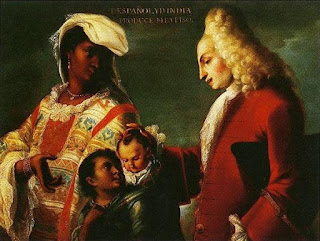
More lovely embroidery, and music, too. Are they playing and singing together as a fun family activity, for money, or is it a lesson? I have no idea. What do you think?


All of these painters lived and worked in 18th century Mexico, then known as New Spain. Some of them were Spanish. Nobody knows Cabrera's parentage, but his godparents were half black. One of the painters was half Spanish and half Indian. One of them had black grandparents but he was able to pass as Spanish and he mostly did. Other known painters of Casta groups are Jose de Ibarra (Afro-Mexican, but passed as Spanish), Juan Correa (he considered himself 'mulatto), and others.
These paintings are called Casta paintings. They are, I think, exclusively from New Spain in the 1700s. These artists were well known in their day, and most of those we know by name were more famous for their other work. They were frequently commissioned to paint religious paintings or portraits of high ranking politicians or churchmen. For centuries, the Casta paintings were ignored or forgotten. I found a 500 page history book entirely on the topic of the history of art in Mexico after Spain colonized her, and there's not a single mention of Casta painting in it, even though all of the above artists are mentioned, but only for their other work! The Casta paintings have regained attention and interest in the last few years.
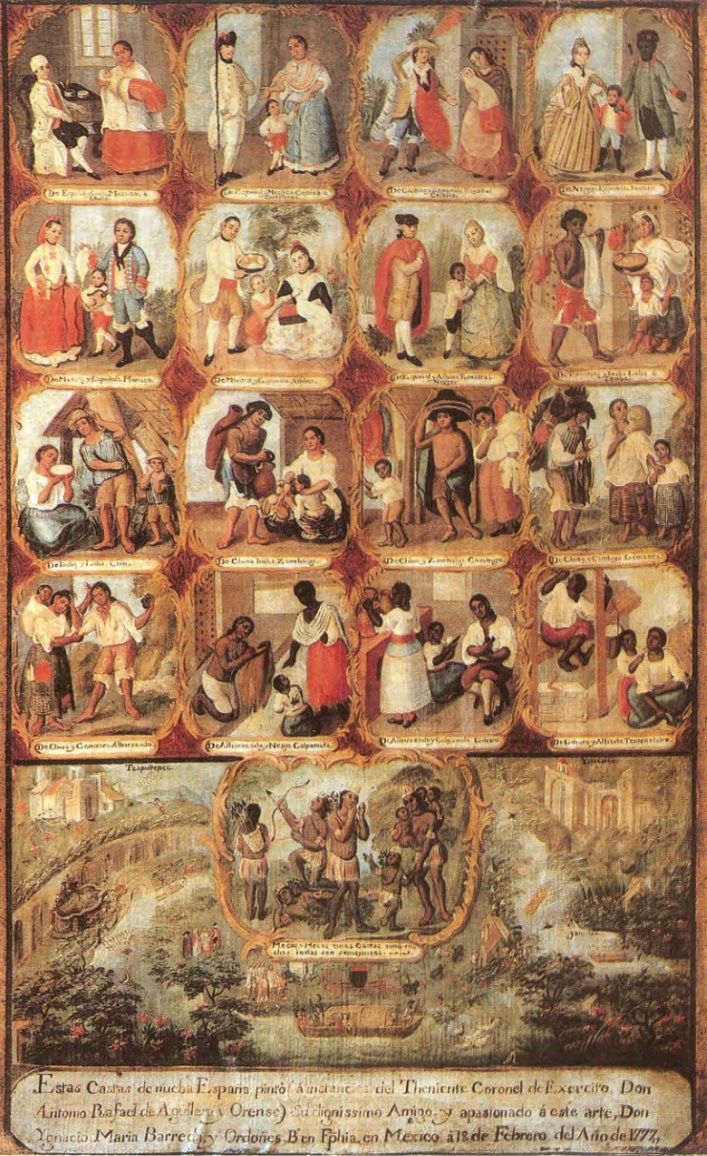
Casta paintings were generally done in sets of 16 groupings. The above artists (and a handful of others) are known to have done them because as well known artists, they signed their names to them. Many Casta paintings are unsigned.
Many of the paintings include local flora and fauna, especially fruits to show a Spanish audience the bounty of the New World. Wikipedia says that Some were likely commissioned by Spanish functionaries as souvenirs of Mexico, because everything in the New World was so different and strange to those back home in Spain (and other parts of Europe). I guess it was kind of like tourists buying postcards, only far more expensive.
Please bear with me as I continue, because at first some of you may be horrified, but I think it's worthwhile to explore this genre.
I heard about these paintings while reading a book by Charles Mann called 1493: Uncovering the World Columbus Made (he's also done another called 1493 for Young People by Charles Mann, which I highly, highly recommend). There is no way to sugar coat this, so I'll just say it. At least one purpose of the paintings was to classify and rank people by their racial background.
According to the author of 1493, they were commissioned by the government and one of their purposes was to help local officials properly classify people under their jurisdiction (it was part of their official ID, their casta designation). This makes sense because the reason for the limited time window on Casta paintings is that they ceased after after the Mexican War of Independence, when legal racial categories were repudiated in independent Mexico. Racial classification could also determine your job opportunities. For example, according to that 1950s art book (I will remember the title before this post is finished!), those classified as mulatto could not join the pottery guild. According to this site, Mexican women with known African ancestry were prohibited from wearing Spanish dress- so the officials needed to know your ancestry to be sure you were following the law. However.... more on that further down.
The sets are always numbered and number 1 is always a Spaniard husband, and the higher the numbers go, the darker the skin (except for the albinos) of the couples. They had weird ideas that Albinism was actually inherited from African ancestry, so there are many albinos represented in the paintings. The racist themes are not so obvious when you look at portraits individually, and presuming you don't know their background or the titles. The painters themselves may be making some commentary of their own, I don't know, but some experts think so, and the family groups are generally so warm, loving, and tender that it's hard for me to see them in their original context. I like them for themselves, looked at individually.
However, if we were to see them in their full groups of sets of 16, the racist intent of the plan is more obvious. Incidentally, often each of the 16 categories was a separate painting, but sometimes a casta painting depicts all 16 in a single canvas, like this one.
I should add, there are a handful of exceptions to the generally warm and loving family scenes. Some casta paintings depict domestic violence- sometimes the husband is beating or threatening to stab the wife, sometimes the wife is beating the husband or coming at him with a knife. But I have only seen three of four of those. Most of those I have seen are fairly represented by the above examples.
The names of the paintings themselves are often problematic, to use a delicate word for an ugly issue, as each of the 16 'types' of children are given names representing their racial heritage as children of mixed marriages. Not all of those names are complimentary. Some are called coyotes, some wolves, and some:
"For instance, a Spaniard and a mestizo produce a castizo (“burned tree”), while a Spaniard and a morisco (a muslim who had been forced to convert to Christianity) produce an albino torna atrás(“Return-Backwards”) and a No te entiendo (“I-Don’t-Understand-You”) with a Cambuja (offspring of an Indian woman and African man) makes a tente en el aire (“Hold-Yourself-in-Mid-Air”)." (source)
That's an assumption in the description I believe- moriscos were not necessarily muslims who were *forced* to convert. Many were forced. Some converted voluntarily, and sometimes died for their faith, because Islam teaches that leaving the religion is punishable by death.
But anyway.There is also one designation that is translated, "I don't even know what you are." I forget which one that is supposed to be. I wonder who came up with those names?
It is interesting to learn that while the government intended them to be used one way, Mann says people actually used the classifications and paintings as a kind of recipe and/or tool for upward mobility. They chose spouses for themselves or their children as a way to move up (remember this is an era and a culture where marriage for social convenience and improvement of your family is an accepted, even desirable and admirable function of marriage anyway), or they might bribe local officials to give them the casta designation they wanted regardless of where they fit- they could use the pictures to say, "see, I pass..." Or, I imagine, they could move to another area and say to the officials in charge of noting these things, 'Yes, my mother was a Spaniard. Don't believe me? Look at the casta paintings on your own walls and you can see that obviously I am in X category and not Y..."
There were also options for those who were not interested in 'passing,' which the book talks about as well, but 'passing' itself had far less baggage in a culture where everybody was doing it and the officials and your neighbors were really just winking at it and everybody knew that everybody else probably had parents or grandparents who had done the same. And it might mean the difference between joining a guild and being a qualified artisan or just being allowed to be the janitor.
In spite of the racist origins of the Casta paintings as a genre, when I look at them individually I cannot help but feel admiration, warmth, and curiosity. I love the details the painters added showing how the families lives and work. I love the dresses. I love the food, the depictions of Mexican plants and wildlife. I love the family warmth and affection shown in most of the pictures. Even Ilona Katzeor, probably the America's biggest expert on Casta paintings, notes, " At the same time these are highly estheticized paintings that function as proud renditions of the local: their exquisite assortment of fruits and textiles alone make them fascinating images of the material culture of the period. And one cannot fail either to notice the great tenderness among the figures which serves to mask any sense of racial tension."
Most of the art critics I read point out that the more European the ancestry, the lower the numeral ranking- so again, if you are looking at the paintings as a numbered group, this is more disturbing and obvious. But looked at without numbers and as individual works, it's a different story. They also point out, those experts, that the higher the numbers, the poorer the subjects are. Well, they are the experts after all. However, I am not sure if that specific aspect is particularly racist rather than realistic. Since your ranking on the chart determined what guilds and jobs you were allowed to have, it would make sense that families classified as a number 13 in a Casta painting series would find it economically more difficult to find work than families classified as a two. The *reasons* were related to race, but the paintings themselves in that regard were not.
For those reasons (the warmth and beauty of the works themselves), I would not hesitate to share them with my younger grandchildren as individual works of art, rather than as a set of Casta paintings showing race. We can discuss that later when the kids are teens (or their parents can, and as the grandma, I have the privilege of leaving the hard discussions to the parents while I give the children candy and we look at pretty pictures together)
In fact, I put together a book of several of my favourites on Shutterfly for just that purpose.
Notes:
In the U.S. the Los Angeles County Museum of Art (LACMA) is known to have a few Casta paintings, including one that was missing for years and turned out to be stored under somebody's couch! There's also a delicious mystery about the remaining missing Casta painting by Cabrera.
If you want to do your own research, there's a bit of biographical info on several of the above painters here (only a small bit of info on Casta paintings, mostly it's about their more religious works)
More paintings and background information here, including a full listing of the various 'castes'.
Some details on the dress and accessories of some Casta portraits here.
SEveral high resolution and beautiful images here.
That art history book which title I could not recall is Colonial art in Mexico by Manuel Toussaint.
If you want to put together your own group of paintings for picture study, and you are using Charlotte Mason's philosophy, this information will help you do so while being faithful to the principles. The picture study is not the time for didacticicism. It's not the place for art history or art appreciation or socio-political history, either. It's the place for introducing children to six works by the same artist, works that you have chosen based on the value of the works themselves, not merely because they present a message you want to deliver.
I have also put together a downloadable, printable packet of 9 of Miguel Cabrera's beautiful family pieces, along with some helps on picture study and background information that you can print out yourself or send to a print shop. You can purchase that here.
(To print, set to landscape, and a high resolution)
The first set is by Miguel Cabrera. During his lifetime he was considered the greatest painter of his time and country:
I love that gleam in the father's eye, and if you look closely you see the blanket is frayed right around the baby's little bottom. And I suspect that oldest child is quite the rascal, don't you?

The mother's skirt! Beautiful embroidery. And I have seen just that same look on a grandchild's face as she is being handed over to daddy

This one below is my favourite. It just gives me warm feelings all over:

The mother's dress in the picture below is, again- sumptious embroidery work. The basket of food is interesting. And is Dad giving the child a lemon or taking it away?

Jose Juaquin Mangon painted the next one:
I think they are taking Dad his lunch at work, a sweet scene.

Below: I wonder what Dad has been writing? Is he perhaps writing a description of the flowers and fruit on the table? But baby has interrupted for some attention- and who needs baby toys when you have a live... parrot?

Juan Rodruiquez Juarez:
Below: Her dress is gorgeous. It's patterned on a native style known as a huipil. His is European, right up that powdered wig.

More lovely embroidery, and music, too. Are they playing and singing together as a fun family activity, for money, or is it a lesson? I have no idea. What do you think?

Morlete Ruiz (I believe he was married twice, and he fathered 19 children!) painted the next set:
What do you see? Who are these people? Why is Ruiz painting their portraits?


All of these painters lived and worked in 18th century Mexico, then known as New Spain. Some of them were Spanish. Nobody knows Cabrera's parentage, but his godparents were half black. One of the painters was half Spanish and half Indian. One of them had black grandparents but he was able to pass as Spanish and he mostly did. Other known painters of Casta groups are Jose de Ibarra (Afro-Mexican, but passed as Spanish), Juan Correa (he considered himself 'mulatto), and others.
These paintings are called Casta paintings. They are, I think, exclusively from New Spain in the 1700s. These artists were well known in their day, and most of those we know by name were more famous for their other work. They were frequently commissioned to paint religious paintings or portraits of high ranking politicians or churchmen. For centuries, the Casta paintings were ignored or forgotten. I found a 500 page history book entirely on the topic of the history of art in Mexico after Spain colonized her, and there's not a single mention of Casta painting in it, even though all of the above artists are mentioned, but only for their other work! The Casta paintings have regained attention and interest in the last few years.
Casta paintings were generally done in sets of 16 groupings. The above artists (and a handful of others) are known to have done them because as well known artists, they signed their names to them. Many Casta paintings are unsigned.
Many of the paintings include local flora and fauna, especially fruits to show a Spanish audience the bounty of the New World. Wikipedia says that Some were likely commissioned by Spanish functionaries as souvenirs of Mexico, because everything in the New World was so different and strange to those back home in Spain (and other parts of Europe). I guess it was kind of like tourists buying postcards, only far more expensive.
Please bear with me as I continue, because at first some of you may be horrified, but I think it's worthwhile to explore this genre.
I heard about these paintings while reading a book by Charles Mann called 1493: Uncovering the World Columbus Made (he's also done another called 1493 for Young People by Charles Mann, which I highly, highly recommend). There is no way to sugar coat this, so I'll just say it. At least one purpose of the paintings was to classify and rank people by their racial background.
According to the author of 1493, they were commissioned by the government and one of their purposes was to help local officials properly classify people under their jurisdiction (it was part of their official ID, their casta designation). This makes sense because the reason for the limited time window on Casta paintings is that they ceased after after the Mexican War of Independence, when legal racial categories were repudiated in independent Mexico. Racial classification could also determine your job opportunities. For example, according to that 1950s art book (I will remember the title before this post is finished!), those classified as mulatto could not join the pottery guild. According to this site, Mexican women with known African ancestry were prohibited from wearing Spanish dress- so the officials needed to know your ancestry to be sure you were following the law. However.... more on that further down.
The sets are always numbered and number 1 is always a Spaniard husband, and the higher the numbers go, the darker the skin (except for the albinos) of the couples. They had weird ideas that Albinism was actually inherited from African ancestry, so there are many albinos represented in the paintings. The racist themes are not so obvious when you look at portraits individually, and presuming you don't know their background or the titles. The painters themselves may be making some commentary of their own, I don't know, but some experts think so, and the family groups are generally so warm, loving, and tender that it's hard for me to see them in their original context. I like them for themselves, looked at individually.
However, if we were to see them in their full groups of sets of 16, the racist intent of the plan is more obvious. Incidentally, often each of the 16 categories was a separate painting, but sometimes a casta painting depicts all 16 in a single canvas, like this one.
I should add, there are a handful of exceptions to the generally warm and loving family scenes. Some casta paintings depict domestic violence- sometimes the husband is beating or threatening to stab the wife, sometimes the wife is beating the husband or coming at him with a knife. But I have only seen three of four of those. Most of those I have seen are fairly represented by the above examples.
The names of the paintings themselves are often problematic, to use a delicate word for an ugly issue, as each of the 16 'types' of children are given names representing their racial heritage as children of mixed marriages. Not all of those names are complimentary. Some are called coyotes, some wolves, and some:
"For instance, a Spaniard and a mestizo produce a castizo (“burned tree”), while a Spaniard and a morisco (a muslim who had been forced to convert to Christianity) produce an albino torna atrás(“Return-Backwards”) and a No te entiendo (“I-Don’t-Understand-You”) with a Cambuja (offspring of an Indian woman and African man) makes a tente en el aire (“Hold-Yourself-in-Mid-Air”)." (source)
That's an assumption in the description I believe- moriscos were not necessarily muslims who were *forced* to convert. Many were forced. Some converted voluntarily, and sometimes died for their faith, because Islam teaches that leaving the religion is punishable by death.
But anyway.There is also one designation that is translated, "I don't even know what you are." I forget which one that is supposed to be. I wonder who came up with those names?
It is interesting to learn that while the government intended them to be used one way, Mann says people actually used the classifications and paintings as a kind of recipe and/or tool for upward mobility. They chose spouses for themselves or their children as a way to move up (remember this is an era and a culture where marriage for social convenience and improvement of your family is an accepted, even desirable and admirable function of marriage anyway), or they might bribe local officials to give them the casta designation they wanted regardless of where they fit- they could use the pictures to say, "see, I pass..." Or, I imagine, they could move to another area and say to the officials in charge of noting these things, 'Yes, my mother was a Spaniard. Don't believe me? Look at the casta paintings on your own walls and you can see that obviously I am in X category and not Y..."
There were also options for those who were not interested in 'passing,' which the book talks about as well, but 'passing' itself had far less baggage in a culture where everybody was doing it and the officials and your neighbors were really just winking at it and everybody knew that everybody else probably had parents or grandparents who had done the same. And it might mean the difference between joining a guild and being a qualified artisan or just being allowed to be the janitor.
In spite of the racist origins of the Casta paintings as a genre, when I look at them individually I cannot help but feel admiration, warmth, and curiosity. I love the details the painters added showing how the families lives and work. I love the dresses. I love the food, the depictions of Mexican plants and wildlife. I love the family warmth and affection shown in most of the pictures. Even Ilona Katzeor, probably the America's biggest expert on Casta paintings, notes, " At the same time these are highly estheticized paintings that function as proud renditions of the local: their exquisite assortment of fruits and textiles alone make them fascinating images of the material culture of the period. And one cannot fail either to notice the great tenderness among the figures which serves to mask any sense of racial tension."
Most of the art critics I read point out that the more European the ancestry, the lower the numeral ranking- so again, if you are looking at the paintings as a numbered group, this is more disturbing and obvious. But looked at without numbers and as individual works, it's a different story. They also point out, those experts, that the higher the numbers, the poorer the subjects are. Well, they are the experts after all. However, I am not sure if that specific aspect is particularly racist rather than realistic. Since your ranking on the chart determined what guilds and jobs you were allowed to have, it would make sense that families classified as a number 13 in a Casta painting series would find it economically more difficult to find work than families classified as a two. The *reasons* were related to race, but the paintings themselves in that regard were not.
For those reasons (the warmth and beauty of the works themselves), I would not hesitate to share them with my younger grandchildren as individual works of art, rather than as a set of Casta paintings showing race. We can discuss that later when the kids are teens (or their parents can, and as the grandma, I have the privilege of leaving the hard discussions to the parents while I give the children candy and we look at pretty pictures together)
In fact, I put together a book of several of my favourites on Shutterfly for just that purpose.
Create your own custom photo books at Shutterfly.com.
(for the next couple of days Shutterfly photo books are around 11 or 12 dollars, 40% off. Periodically they go on sale for half off. Don't pay full price)
(for the next couple of days Shutterfly photo books are around 11 or 12 dollars, 40% off. Periodically they go on sale for half off. Don't pay full price)
Tip: I include this in the booklet as well, but because the titles of the paintings are troublesome, I wouldn't use them with younger children at all. What I would do is ask them to look at the painting and then think of the title they would choose for a painting. You would not necessarily do this every time, as it might become tiresome.
Notes:
In the U.S. the Los Angeles County Museum of Art (LACMA) is known to have a few Casta paintings, including one that was missing for years and turned out to be stored under somebody's couch! There's also a delicious mystery about the remaining missing Casta painting by Cabrera.
If you want to do your own research, there's a bit of biographical info on several of the above painters here (only a small bit of info on Casta paintings, mostly it's about their more religious works)
More paintings and background information here, including a full listing of the various 'castes'.
Some details on the dress and accessories of some Casta portraits here.
SEveral high resolution and beautiful images here.
That art history book which title I could not recall is Colonial art in Mexico by Manuel Toussaint.
If you want to put together your own group of paintings for picture study, and you are using Charlotte Mason's philosophy, this information will help you do so while being faithful to the principles. The picture study is not the time for didacticicism. It's not the place for art history or art appreciation or socio-political history, either. It's the place for introducing children to six works by the same artist, works that you have chosen based on the value of the works themselves, not merely because they present a message you want to deliver.
I have also put together a downloadable, printable packet of 9 of Miguel Cabrera's beautiful family pieces, along with some helps on picture study and background information that you can print out yourself or send to a print shop. You can purchase that here.
(To print, set to landscape, and a high resolution)
Subscribe to:
Posts (Atom)